
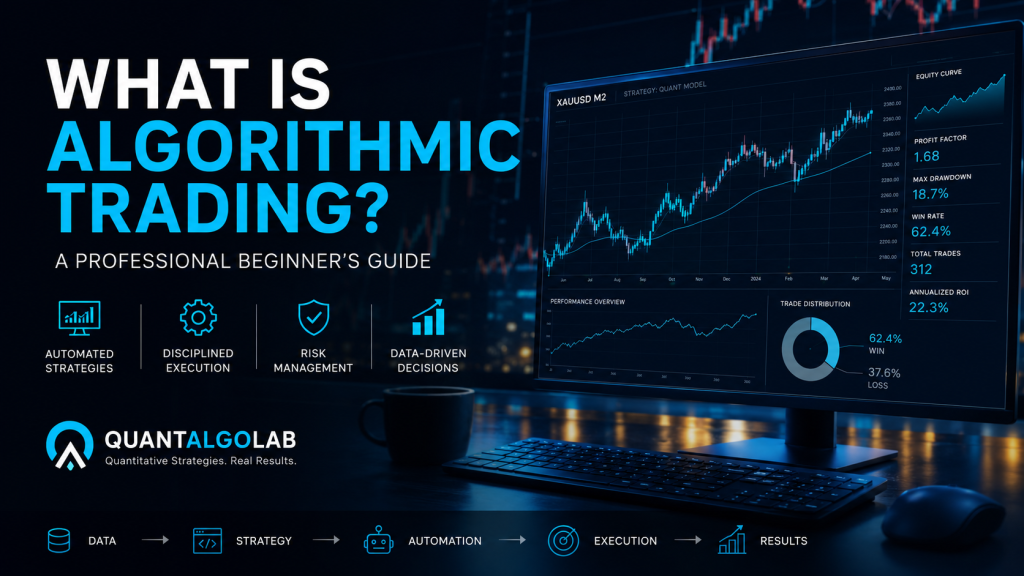
Algorithmic trading is the process of using computer programs to automatically execute trading decisions based on predefined rules.
For a broader explanation, Investopedia provides a detailed algorithmic trading definition and overview of how automated systems work.
Traders looking for professionally developed algorithmic trading strategies can explore our Strategy Library.
Instead of manually monitoring charts and placing trades, algorithmic trading systems analyze market conditions, identify opportunities, and execute trades without emotional interference.
Today, algorithmic trading is widely used by hedge funds, proprietary trading firms, institutions, and increasingly by retail traders seeking consistency and disciplined execution.
In this guide, you’ll learn how algorithmic trading works, its advantages, risks, and how traders use platforms such as cTrader to automate their trading strategies.
How Does Algorithmic Trading Work?
Every algorithmic trading system follows a predefined set of rules.
These rules can be based on technical indicators, price action, volatility measurements, trend filters, time restrictions, or risk management conditions.
When all required conditions are met, the algorithm automatically executes a trade according to its programming.
A typical algorithmic strategy includes:
- Entry rules
- Exit rules
- Stop-loss management
- Take-profit management
- Position sizing
- Risk controls
Advantages of Algorithmic Trading
Algorithmic trading offers several advantages compared to discretionary trading.
The biggest benefit is consistency. A properly designed trading system follows the same rules every time without emotional interference.
Additional benefits include:
- Faster execution
- Reduced human error
- Backtesting capability
- Better risk management
- Ability to monitor multiple markets simultaneously
- Scalability across different assets
Risks of Algorithmic Trading
While algorithmic trading can improve discipline, it is not risk-free.
Poorly designed strategies can experience prolonged drawdowns, overfitting, or unexpected behavior during changing market conditions.
Common risks include:
- Market volatility
- Execution slippage
- Broker-related issues
- Over-optimization
- Insufficient historical testing
Understanding financial market volatility is important when designing any automated trading strategy.
Professional traders focus heavily on risk-adjusted returns rather than raw profitability.
What Is a Trading Bot?
A trading bot is software that automatically executes trades based on predefined logic.
Modern trading bots often include:
- Trend filters
- Momentum indicators
- Volatility filters
- Dynamic stop-loss management
- Position sizing controls
- Drawdown protection systems
Professional trading bots are designed to operate consistently while maintaining strict risk controls.
Algorithmic Trading on cTrader
cTrader is one of the most popular platforms for algorithmic trading.
Its cAlgo environment allows traders to develop custom trading robots known as cBots using C# programming.
Advantages of cTrader include:
- Fast execution
- Advanced backtesting
- Tick-data simulation
- Optimization tools
- VPS compatibility
- Professional-grade charting
Many quantitative traders prefer cTrader because it combines flexibility with institutional-quality execution.
Is Algorithmic Trading Profitable?
Algorithmic trading can be profitable when strategies are built around robust market logic, risk management, and extensive testing.
Successful traders focus on:
- Return on investment (ROI)
- Maximum drawdown
- Profit factor
- Trade consistency
- Risk-adjusted performance
There is no guaranteed profit in financial markets, but disciplined algorithmic systems can help remove emotional decision-making and improve consistency.
Conclusion
Algorithmic trading combines technology, data analysis, and risk management into a systematic approach to market participation.
Whether you’re a beginner exploring automation or an experienced trader seeking consistency, understanding algorithmic trading is the first step toward building a disciplined trading process.
Explore Professional Algorithmic Trading Strategies
QuantAlgoLab provides institutional-style automated trading systems designed for traders seeking consistency, risk control, and disciplined execution across different market conditions.
The most successful systems focus not only on returns but also on controlling risk and maintaining long-term stability.
Frequently Asked Questions
What is algorithmic trading?
Algorithmic trading uses computer programs to automatically execute trades according to predefined rules.
Is algorithmic trading profitable?
It can be profitable when supported by robust strategy design, proper risk management, and extensive testing.
Do I need programming skills for algorithmic trading?
Not always. Many traders use pre-built trading bots, although programming knowledge provides greater flexibility.
What platform is best for algorithmic trading?
Popular platforms include cTrader, MetaTrader, NinjaTrader, and TradingView depending on the trader’s requirements.